What to Look for in a Vendor Contract Before You Sign
Before you sign a vendor agreement, make sure you know what you're agreeing to. Here's what small business owners need to check before committing to any supplier or service provider.
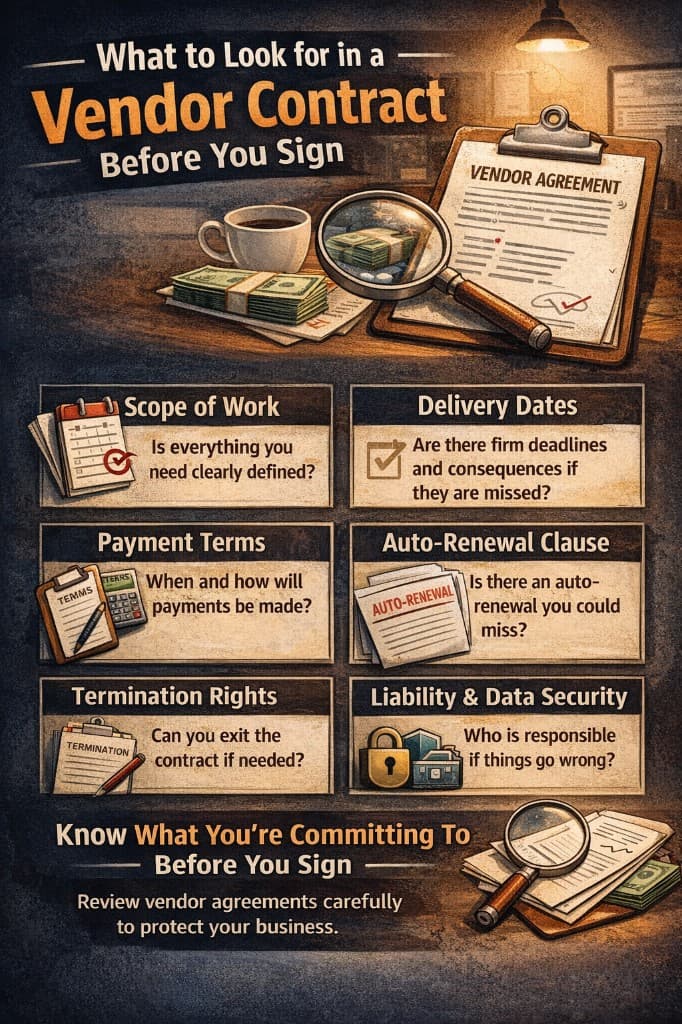
Vendor contracts are some of the most routinely signed and least carefully read agreements in business. A new software tool, a supplier relationship, a marketing agency, a fulfillment partner — each one comes with a contract that feels like a formality when everything is going well. The problem only surfaces when something goes wrong, and by then you are already locked in.
Research by World Commerce and Contracting found that ineffective contract management costs companies approximately 9.2% of their annual revenue on average. For a small business, that is not an abstract statistic. That is cash flow, growth budget, and time you do not have to spare.
Understanding what to look for in a vendor contract before you sign is one of the highest-leverage habits you can build as a business owner. Most of the clauses that cause problems later are not buried in fine print. They are just the ones people skip because the conversation felt positive and the pressure to move forward was high.
Start With the Scope of Work
The most important section of any vendor contract is the one that defines exactly what the vendor is agreeing to deliver. Vague scope language is the single most common source of disputes between businesses and their vendors.
When the scope is unclear, vendors have room to interpret their obligations narrowly, and you have no objective basis to push back when delivery falls short. A contract that says a vendor will "provide marketing services" is almost meaningless. A contract that specifies deliverables, timelines, revision limits, and quality benchmarks gives you something to point to.
Legal experts who regularly audit vendor agreements note that contracts without defined performance standards are extremely difficult to enforce, because the facts become subjective the moment a dispute arises. If you cannot measure whether a vendor met their obligation, you are going to struggle to hold them accountable.
Before you sign, make sure the scope section answers these questions clearly: what exactly is being delivered, by when, to what standard, and what happens if the vendor needs to change the scope after work has begun.
Delivery Deadlines and Accountability
A vendor contract without hard deadlines is a vendor contract without accountability. When delivery dates are not written into the agreement, or when there are no consequences for missing them, vendors face very little pressure to prioritize your work.
For small businesses that depend on predictable timelines to keep their own operations running, a delayed vendor can cause a cascade of problems. Stalled projects, supply shortages, missed customer commitments, and lost revenue can all trace back to a contract that never required the vendor to show up on time.
The fix is straightforward. Insist on specific delivery dates in the contract, and include provisions that address what happens when deadlines are missed. That does not have to mean penalties that punish vendors harshly. It means both parties have agreed in writing on what the expectations are, which is the foundation of any functional business relationship.
Payment Terms Work Both Ways
Payment terms protect you as much as they protect the vendor, and they deserve more attention than most people give them. Vague payment language creates unnecessary risk on both sides of the agreement.
When contracts do not specify when payments are due, how they must be made, or what happens if a payment is delayed, disputes become almost inevitable. Small businesses rely on predictable cash flow, and unclear payment provisions can strain finances and relationships in ways that are entirely avoidable.
What you want to see in a vendor contract is specific: when invoices will be issued, how many days you have to pay, what the late fee structure looks like, and under what conditions either party can dispute an invoice. These details are not complicated to include, but they make an enormous difference when something unexpected happens.
On the flip side, if you are a business paying vendors on net 30 or net 60 terms, make sure those terms are explicitly stated in the contract. Do not assume that a verbal agreement about payment timing will hold up later.
Auto-Renewal Clauses Are Everywhere
This is the clause that catches businesses off guard more than almost any other. Auto-renewal provisions are standard in vendor contracts, and they are often written in ways that make it easy to miss the window to opt out.
A typical auto-renewal clause will renew the contract for another full term, sometimes a full year, unless you provide written notice of cancellation within a specific window that might be 30, 60, or even 90 days before the contract expires. Miss that window and you are committed to another year of service whether you want it or not.
Legal analysts who track vendor agreement risks consistently flag inconsistent contract tracking as one of the biggest operational mistakes businesses make. Tracking auto-renewals and expiration dates is an important step to avoid renewing a contract you might otherwise have wanted to terminate.
Before you sign, read the renewal clause carefully. Know exactly when the contract renews, what the notice window is, and what form that notice needs to take. Then put a reminder in your calendar well before that deadline.
Termination Rights Need to Be Mutual
Every business relationship eventually ends. The question is whether the contract gives you a reasonable way to exit when the time comes, or whether it traps you in an agreement that no longer serves your needs.
Many vendor contracts are written to make termination as difficult as possible. They may require cause for termination, meaning you can only exit if the vendor has materially breached the agreement. They may include long notice periods. Some include financial penalties for early termination that make leaving more expensive than staying.
You should always have the right to terminate a vendor relationship with reasonable notice, even if neither party has done anything wrong. Business needs change. Technology improves. Better vendors emerge. A contract that locks you in without a fair exit does not reflect a balanced relationship.
Contracts should allow for termination not just in the event of a breach, but also simply because it makes the most sense for the business. If the termination section only protects the vendor, that is worth negotiating before you sign.
Liability and Indemnification
This section gets overlooked constantly, and it matters a great deal. The liability and indemnification clauses in a vendor contract determine who is financially responsible when something goes wrong.
Without a well-drafted indemnification clause, your business could be on the hook even for your vendor's mistakes. If a vendor causes a data breach, misses a delivery that costs you a client, or produces work that leads to a legal claim, the liability provisions in the contract determine how that plays out.
Look for limitations of liability that cap the vendor's financial exposure at a level that is far below what their failure could actually cost you. If a software vendor's outage costs your business $200,000 and their liability cap is $5,000, you are essentially self-insuring against their mistakes.
This does not mean every vendor will negotiate these terms. But you should understand what you are accepting before you sign.
Data and Confidentiality Provisions
If you are sharing any customer data, financial information, or business intelligence with a vendor, the contract needs to clearly address how that information is handled and protected.
A 2024 report found that 98% of organizations have a relationship with at least one third-party vendor that experienced a breach in the last two years. That is not a reason to avoid vendors. It is a reason to make sure your contracts hold them accountable for protecting your information.
The confidentiality section should define what counts as sensitive information, how the vendor is required to store and protect it, what happens in the event of a breach, and what restrictions exist on the vendor sharing your information with subcontractors or third parties.
If those protections are vague or missing entirely, you are taking on risk that belongs on the vendor's side of the agreement.
Read It Before You Sign It
This sounds obvious, but the number of business owners who sign vendor agreements without fully reading them is significant. The pressure to move quickly, the trust built during the sales process, and the sheer volume of contracts that cross a business owner's desk all push in the same direction — sign now, figure it out later.
The problem is that later usually means after something has already gone wrong. By then the leverage is gone and you are working from inside an agreement that was not written with your interests as the priority.
Taking thirty minutes to read a vendor contract carefully before signing it is one of the most cost-effective things a small business owner can do. If something is unclear, ask. If a term seems unreasonable, push back. Most vendors expect negotiation and would rather adjust a clause than lose a customer.
Symvaci reviews vendor agreements and other contracts in minutes, flagging risky clauses and translating complex language into plain English. Upload your vendor contract to Symvaci before you sign.
Sources
- World Commerce and Contracting via Concord — "The Hidden Costs of Ineffective Contract Management": concord.app
- RichardsonClement, P.C. — "Top 3 Mistakes Small Businesses Make in Vendor Contracts": richardson.law
- Venminder — "Top 3 Risks of Vendor Contracts": venminder.com
- Pitcoff Law Group — "The Hidden Risks in Vendor Agreements": pitcofflawgroup.com
- Padula Bennardo Levine, LLP — "The Contract Mistakes Small Business Owners Make": pbl-law.com
- Procurement Tactics — "Contract Management Statistics 2025": procurementtactics.com
Ready to review your next contract?
Upload any contract and get a plain English breakdown in minutes. Spot risky clauses, missing terms, and exactly what to push back on.
Start Reviewing