What Every Service Agreement Needs Before You Sign
A service agreement protects both sides of a business relationship — but only if it covers the right things. Here's what to look for before you sign.
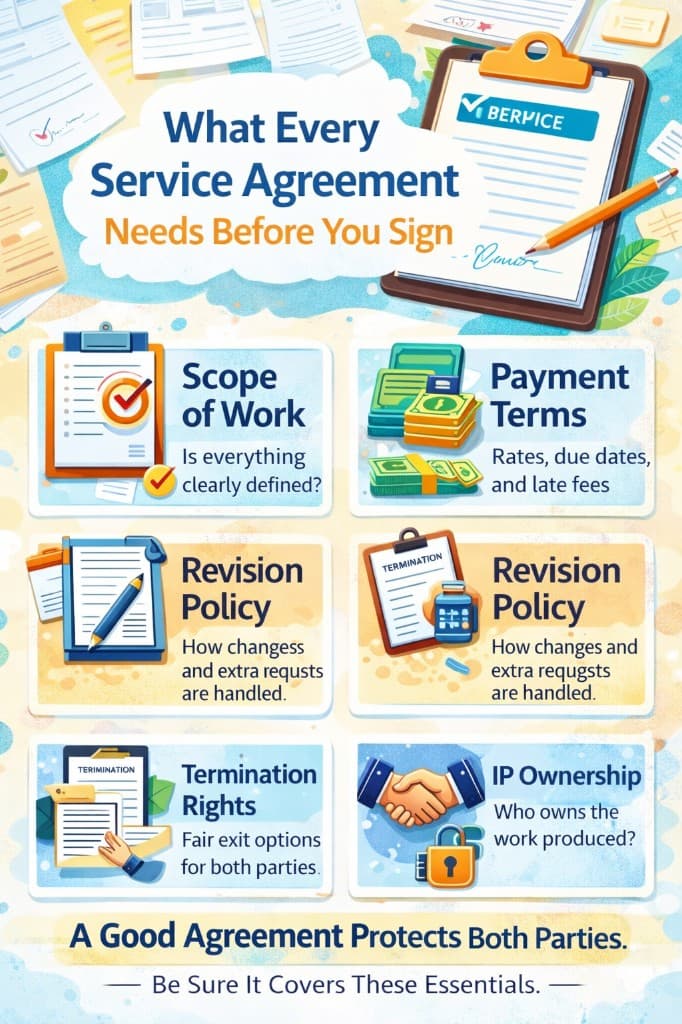
Service agreements are the most common contract most small business owners and freelancers will ever sign. They cover everything from a web designer taking on a new client to a consultant engaging a company for six months of work. They look routine because they are routine. That familiarity is exactly why they cause so many problems.
Over 64 million Americans are currently freelancing, and that number keeps climbing. The majority of those working relationships are governed by some form of service agreement. But signing one without understanding what is actually in it, or what is missing from it, is one of the fastest ways to end up in a payment dispute, a scope disagreement, or a situation where no one can agree on who was supposed to do what.
A service agreement does not need to be long or complicated to be effective. It does need to cover certain things specifically. Here is what to look for before anyone signs.
A Scope of Work That Leaves Nothing Vague
The scope of work section is the foundation of any service agreement, and it is the clause that causes the most disputes when it is written carelessly. Vague scope language creates room for both parties to interpret their obligations differently, and those interpretations tend to diverge at exactly the moment when something is not going according to plan.
A strong scope section defines what services will be provided, what the deliverables are, how many revisions or rounds of feedback are included, what is explicitly not included, and what happens if additional work is requested beyond what was agreed. That last point matters more than most people realize. Scope creep, where projects gradually expand beyond the original agreement without a corresponding adjustment in compensation, is one of the most common ways service agreements break down.
If the scope section of a service agreement reads like a general description rather than a specific set of deliverables, that is a problem worth addressing before work begins. Contracts should force both parties to think through all the relevant issues of the relationship and negotiate the harder ones before emotions are involved.
Payment Terms That Are Specific Enough to Be Enforceable
Payment terms are where service agreements most frequently fail the people who sign them. A freelancer or service provider who does the work and then cannot get paid because the contract did not clearly establish when and how payment was due has almost no leverage. A client who prepays for services and then faces a dispute about what they received has already given away their main source of leverage.
The payment section of a service agreement should specify the total amount or rate, the billing schedule, the payment method, and the number of days the client has to pay after receiving an invoice. It should also address what happens when payment is late. Including a late payment provision, whether that is interest on overdue balances or a flat fee, communicates that the payment terms are real expectations rather than suggestions.
Where possible, requiring a deposit or milestone-based payments is worth negotiating. Asking for a portion of payment upfront or tying payments to project milestones reduces the financial risk if the client fails to pay the full amount at completion. This is standard practice in many service industries, and most reasonable clients expect it.
A Clear Revision and Change Order Policy
One of the most overlooked sections of any service agreement is the one that governs what happens when the scope needs to change. Almost every service engagement involves some change after work begins. The question is whether those changes are handled professionally or whether they become the source of a dispute.
A change order or amendment policy should establish that any changes to the scope, timeline, or deliverables need to be agreed upon in writing before additional work begins, and that changes to the scope may affect the price and timeline. Without this, clients can request additional work informally and later dispute whether they agreed to pay for it. Service providers can make changes to deliverables without a client's explicit agreement and later face pushback on the final product.
The goal is not to make the relationship rigid. The goal is to make sure both parties are on the same page when circumstances change, which they almost always do.
Termination Rights for Both Sides
Every service agreement should address how and when the relationship can end. This is not a pessimistic clause. It is a practical one. Business relationships end for all kinds of reasons that have nothing to do with anyone doing anything wrong, and a contract that only allows termination when there has been a breach does not reflect the reality of how business works.
Both parties should have the right to exit the agreement with reasonable written notice. The contract should also specify what happens to work in progress and payment for services already rendered when the agreement ends. If a client terminates a project halfway through, what is owed to the service provider for the work completed? If a service provider needs to step away from a project, how much notice must they give and what are they responsible for wrapping up?
These questions are not pleasant to think about at the start of a new working relationship, but they are far better addressed before work begins than in the middle of a dispute.
Intellectual Property Ownership
In any service agreement that involves the creation of content, software, designs, or other original work, the question of who owns what the service provider creates is critically important and frequently mishandled.
By default, in many cases, the creator retains ownership of their work unless the contract explicitly transfers those rights to the client. That means a business that pays a designer to create a logo, or a developer to build a custom feature, may not actually own that work unless the contract includes clear intellectual property assignment language.
From the client's perspective, the contract should specify that all work product created under the agreement becomes the client's property upon final payment. From the service provider's perspective, it is equally important to understand what rights you are transferring and whether you retain the ability to use the work in your portfolio or for other purposes.
If the IP section of a service agreement is vague or missing entirely, that is not a minor oversight. It is a structural gap that can create real problems down the road.
A Dispute Resolution Clause
No one enters a service agreement expecting a dispute, but disputes happen. When they do, the contract should specify how they will be resolved, where they will be resolved, and which state's laws apply.
Without a dispute resolution clause, any disagreement could end up in litigation, which is expensive and time-consuming for both parties. Most well-drafted service agreements specify that disputes will first go through mediation or arbitration before either party can pursue legal action. Mediation and arbitration are typically faster and less expensive than going to court, and they give both parties a path to resolution that does not require a lawsuit.
The governing law clause, which specifies which state's laws apply to the agreement, also matters more than people realize, particularly if the two parties are in different states. If a dispute arises, the jurisdiction specified in the contract often determines where the case is heard and under what legal framework.
Confidentiality
If either party will have access to the other's sensitive business information during the engagement, the service agreement should address confidentiality directly. This does not require a separate NDA in every case. A well-drafted confidentiality clause within the service agreement itself can cover the same ground.
The clause should define what counts as confidential information, how long the confidentiality obligation lasts after the agreement ends, and what happens if confidential information is disclosed improperly. For businesses sharing client data, financial information, or proprietary processes with outside service providers, this section is not optional. It is one of the primary reasons a service agreement exists.
Read It With Fresh Eyes
The most important thing anyone can do before signing a service agreement is to actually read it. That sounds obvious, but the pressure of a new client relationship, the excitement of a new project, and the social awkwardness of slowing down to scrutinize a contract all push in the direction of signing quickly and sorting things out later.
Later is almost always more expensive. A misunderstanding about scope or payment that surfaces after work has begun is far harder to resolve than one that gets addressed before the first invoice.
Symvaci reviews service agreements and other contracts in minutes, flags risky or missing clauses, and explains what every section means in plain English. Upload your service agreement to Symvaci before you sign.
Sources
- High5Test / Upwork — "30+ Comprehensive Freelance Statistics in the US (2024/2025)": high5test.com
- FreelancerMap — "Freelance Contract: Must-Have Clauses, How to Negotiate": freelancermap.com
- Sirion — "The Essential Guide to Service Agreements": sirion.ai
- UpCounsel — "Agreement to Pay for Services": upcounsel.com
- Padula Bennardo Levine, LLP — "The Contract Mistakes Small Business Owners Make": pbl-law.com
- Denevan Falon Law Firm — "Understanding Non-Payment Disputes: Common Causes and Legal Recourse": southdakotatrustestatelitigationlaw.com
Ready to review your next contract?
Upload any contract and get a plain English breakdown in minutes. Spot risky clauses, missing terms, and exactly what to push back on.
Start Reviewing