What Is Contract Management and Why Does It Matter for Small Businesses?
Poor contract management costs businesses an average of 9% of annual revenue. Here's what contract management actually means, and what small businesses can do about it.
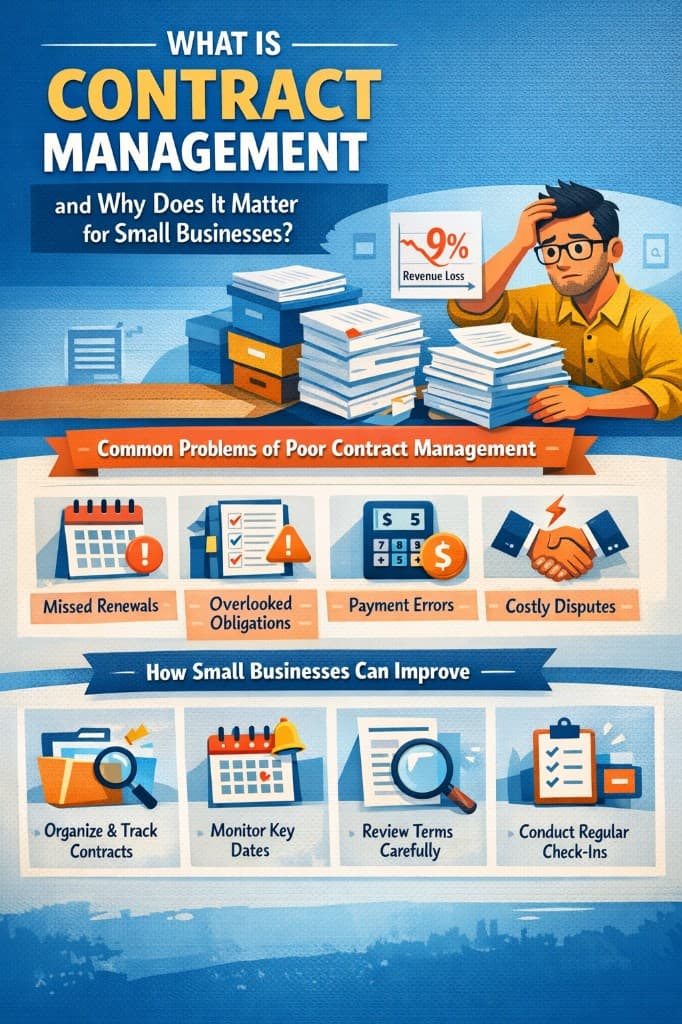
Most small business owners think about contracts at two specific moments: when they are about to sign one and when something has gone wrong with one. Everything in between, the period when the contract is actually active and governing a real business relationship, tends to get very little attention.
That gap is exactly what contract management is designed to close. And the cost of ignoring it is not theoretical. Research by World Commerce and Contracting found that poor contract management costs organizations an average of 9% of their annual revenue. For a business doing $500,000 a year, that is $45,000 quietly walking out the door through missed renewals, overlooked obligations, payment errors, and disputes that should never have escalated.
What Contract Management Actually Means
Contract management is the process of handling contracts from creation through execution and beyond — tracking obligations, monitoring performance, staying on top of renewal dates, and making sure both parties are holding up their end of the agreement.
For large enterprises with legal departments, contract management often involves dedicated software, formal workflows, and teams of people. For small businesses, it does not need to be that complicated. But it does need to exist in some form.
At its most basic level, contract management for a small business means knowing what contracts you have, what they require of you, when they expire, and whether the other party is meeting their obligations. That is a surprisingly high bar for most businesses to clear. Only 22% of organizations feel confident in how they track and manage their contracts, according to research cited by Procurement Tactics. That means the vast majority of businesses are operating with significant blind spots in their own agreements.
The Most Common Ways Small Businesses Lose Money on Contracts
Missed Renewal Dates
Auto-renewal clauses are one of the most common ways small businesses end up locked into agreements they no longer need. A contract renews automatically because no one was tracking the cancellation window, and suddenly the business is committed to another year of a service it stopped using six months ago.
This happens constantly. Research shows that 71% of businesses cannot locate at least 10% of their contracts at any given time. If you cannot find a contract, you almost certainly cannot track when it renews or what notice period is required to opt out.
Unmonitored Obligations
Every contract creates obligations on both sides. Deliverables, payment schedules, reporting requirements, exclusivity terms, performance standards — these are not just details that matter when a dispute arises. They are active requirements throughout the life of the agreement.
When obligations go untracked, businesses miss deadlines, fail to enforce their own rights, and sometimes inadvertently breach agreements they did not realize had specific requirements. Research by Loio found that 71% of contracts are never monitored for deviations from standard terms, leaving companies exposed to conditions they agreed to but are not actively managing.
Payment Errors and Overcharges
Contracts lock in pricing, discounts, and payment terms. When those contracts are not actively managed, businesses routinely pay more than they agreed to, miss volume discounts they were entitled to, or fail to apply credits they had negotiated. The Harvard Business Review has estimated that anywhere between 5% and 40% of a contract's value can be lost through poor management of pricing and payment terms alone.
For a small business with a handful of vendor contracts, even modest overcharges or missed credits add up quickly over the course of a year.
Disputes That Could Have Been Prevented
Most contract disputes do not emerge suddenly. They build up over time through small misunderstandings, untracked changes, and obligations that slip without anyone noticing. By the time the dispute is visible, both parties have usually accumulated grievances that make resolution harder and more expensive.
Active contract management interrupts that pattern by keeping both parties aligned throughout the engagement, not just at signing and at the point of conflict. Research from Loio found that 64% of civil lawsuits in U.S. courts involve contract disputes, which is a striking figure when you consider how many of those disputes started with something that could have been caught and addressed earlier.
What Good Contract Management Looks Like for a Small Business
You do not need enterprise software or a legal team to manage contracts well. What you need is a consistent process and the discipline to follow it.
Know what you have signed. Every active contract should be stored in one place and accessible. This sounds obvious, but research consistently shows that a significant portion of businesses cannot locate a meaningful share of their own contracts when they need them. A shared folder, a simple spreadsheet, or a basic contract storage tool all work. What does not work is relying on email inboxes and memory.
Track key dates. For every contract, know when it expires, when any auto-renewal notices are due, and when major deliverables or payment milestones are scheduled. Set calendar reminders well in advance of renewal deadlines. Missing a 30-day cancellation window because the date was not tracked is an entirely avoidable cost.
Review contracts before you sign them. This is the point where most of the leverage exists. Once a contract is executed, your options narrow considerably. Understanding the key terms, flagging unusual clauses, and negotiating the points that matter before you sign is far more effective than trying to manage your way around a bad agreement after the fact.
Check in on active agreements periodically. You do not need to audit every contract every month. But a quarterly review of your most significant agreements, checking whether both parties are meeting their obligations and whether anything has changed, can surface issues before they become disputes.
Read amendments and renewals carefully. Renewing a contract or signing an amendment to an existing one is not a formality. Terms can change, sometimes significantly, between the original agreement and a renewal. Treat renewals like new contracts and review them accordingly.
The Moment That Matters Most
All of the contract management practices above become much easier when the contract is well-written and well-understood from the start. A contract full of vague language, unclear obligations, and one-sided terms is harder to manage regardless of how organized your tracking system is.
The single highest-leverage point in contract management for a small business is the moment before signing. That is when you have the most information about what you are agreeing to and the most ability to shape the terms. It is also the moment most people spend the least time on.
Symvaci reviews contracts in minutes, identifies risky or unclear clauses, and explains what every section actually means in plain English. Upload your contract to Symvaci before you sign and start your contract management on the right foot.
Sources
- World Commerce and Contracting via Concord — "The Hidden Costs of Ineffective Contract Management": concord.app
- Loio — "Contract Management Statistics and Trends 2025": loio.com
- Procurement Tactics — "Contract Management Statistics 2025": procurementtactics.com
- ContractSafe — "53 Contract Management Statistics Ahead of 2025": contractsafe.com
- Harvard Business Review via ContractPodAi — "Contract Management Statistics and Trends 2025": contractpodai.com
Ready to review your next contract?
Upload any contract and get a plain English breakdown in minutes. Spot risky clauses, missing terms, and exactly what to push back on.
Start Reviewing